
A Security Control Is Not Real Until It Can Be Operated
Why deployment, observability, ownership, recovery and validation determine whether security exists beyond policy and tooling.
Diego Concha, Innershell Labs
Executive premise
CORE THESIS
A security control is not the mechanism an organization bought, configured or documented. It is the capability the organization can reliably deploy, observe, maintain, test, recover and govern under real operating conditions.
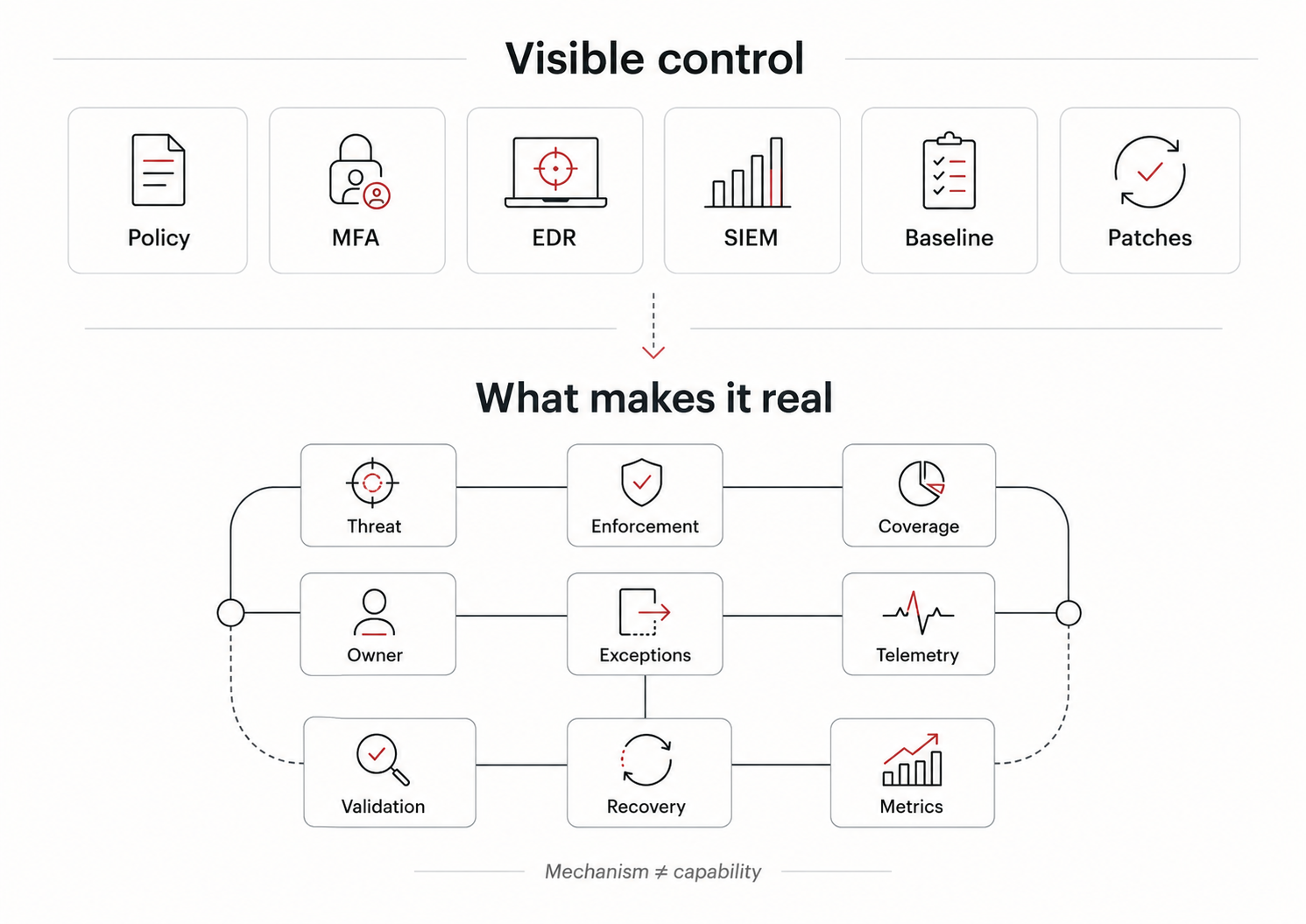
Organizations often describe their security posture through inventories: identity controls, endpoint agents, SIEM rules, hardening baselines, patching tools, data loss prevention, privileged access management and dozens of policies. The inventory may be accurate, yet it can still create a misleading impression. A component may exist while the capability it is supposed to create does not.
A policy can be correct but unenforced. A configuration can be deployed but gradually drift. An endpoint agent can be installed but unhealthy. A detection can exist but depend on telemetry that is incomplete. A patch can be available but operationally impossible to deploy to the assets that matter most. A security platform can report impressive coverage while silently excluding the systems that carry the greatest business risk.
The difference between a control that exists and one that merely appears to exist is operational reality. Security becomes real only when the organization understands what the control is expected to prevent or detect, where it makes decisions, how it is deployed, what population it covers, what happens when it fails, who owns it, how exceptions are governed and how effectiveness is demonstrated.
For a CISO, this is not a semantic distinction. It is the difference between funded capability and unrecognized exposure. For engineers, it is the difference between a feature and a dependable system. For incident responders, it is the difference between expected containment and discovering during an incident that the control was never operating in the critical path.
1. The comforting illusion of control
Security programs naturally gravitate toward things that can be counted. Products can be purchased, licenses can be assigned, policies can be approved, rules can be enabled and projects can be marked complete. These are necessary activities, but they are not proof that risk has been reduced.
The illusion begins when the organization treats the existence of a mechanism as evidence of an operating capability. A control is then represented by a binary statement: MFA is enabled, EDR is deployed, logging is centralized, critical vulnerabilities are patched, privileged access is controlled. Each statement compresses a complex system into a checkbox.
That compression hides the questions that determine whether the statement is materially true:
-
Enabled for whom, on which systems and through which authentication paths?
-
Deployed to what percentage of the relevant population, measured against which denominator?
-
Healthy at what point in time, and how quickly is an unhealthy state detected?
-
Capable of preventing the threat scenario that justified the investment?
-
Observable when bypassed, degraded or operating in a fallback mode?
-
Owned by a team with authority, capacity and incentives to maintain it?
-
Validated against realistic adversarial behavior, not only vendor documentation?
-
Recoverable when an update, dependency or policy change creates business disruption?
A mature security program cannot avoid abstraction; executives need concise representations of posture. But abstraction becomes dangerous when it removes the conditions under which a control is effective. The board may hear that phishing-resistant MFA is deployed, while the incident response team later discovers that administrators can still authenticate through a legacy path, service accounts are exempt, session tokens are reusable and device trust is not enforced for the workflows that matter.
THE EXECUTIVE DISTINCTION
The question is not whether the organization purchased or enabled the control. The question is whether the control changes the outcome of the scenario it was designed to address.
Control intent is not control reality
A policy expresses intent. A technical mechanism creates the possibility of enforcement. An operational control exists only when the mechanism is embedded in a maintained system of people, processes, dependencies, telemetry and decisions.
This is why two organizations can own the same security technology and carry radically different risk. One has mapped the control to threat scenarios, established ownership, engineered deployment and rollback, tested failure modes, instrumented health and coverage, and validated the result. The other has enabled default settings, accepted broad exceptions and relies on the product dashboard as its primary source of assurance.
2. A control is a system, not a configuration
Security controls are often discussed as isolated mechanisms: a rule, agent, policy, gateway, restriction or approval. In production, however, every meaningful control is a distributed socio-technical system. It depends on assets, identity, software versions, network paths, telemetry pipelines, administrative processes, support teams, vendor services and business behavior.
Consider application allowlisting. The enforcement component may be a policy engine in the operating system. But the actual control includes software inventory, certificate trust, packaging workflows, exception handling, update channels, help desk procedures, emergency bypass, policy distribution, compatibility testing, endpoint health, audit data and a process for identifying drift. If any of these elements fails, the control may become unavailable, ineffective or operationally intolerable.
The same pattern applies to authorization, endpoint protection, cloud guardrails, patching, detection rules, data controls and phishing-resistant authentication. The enforcement point is only one component. The control is the entire chain that makes the enforcement reliable and sustainable.
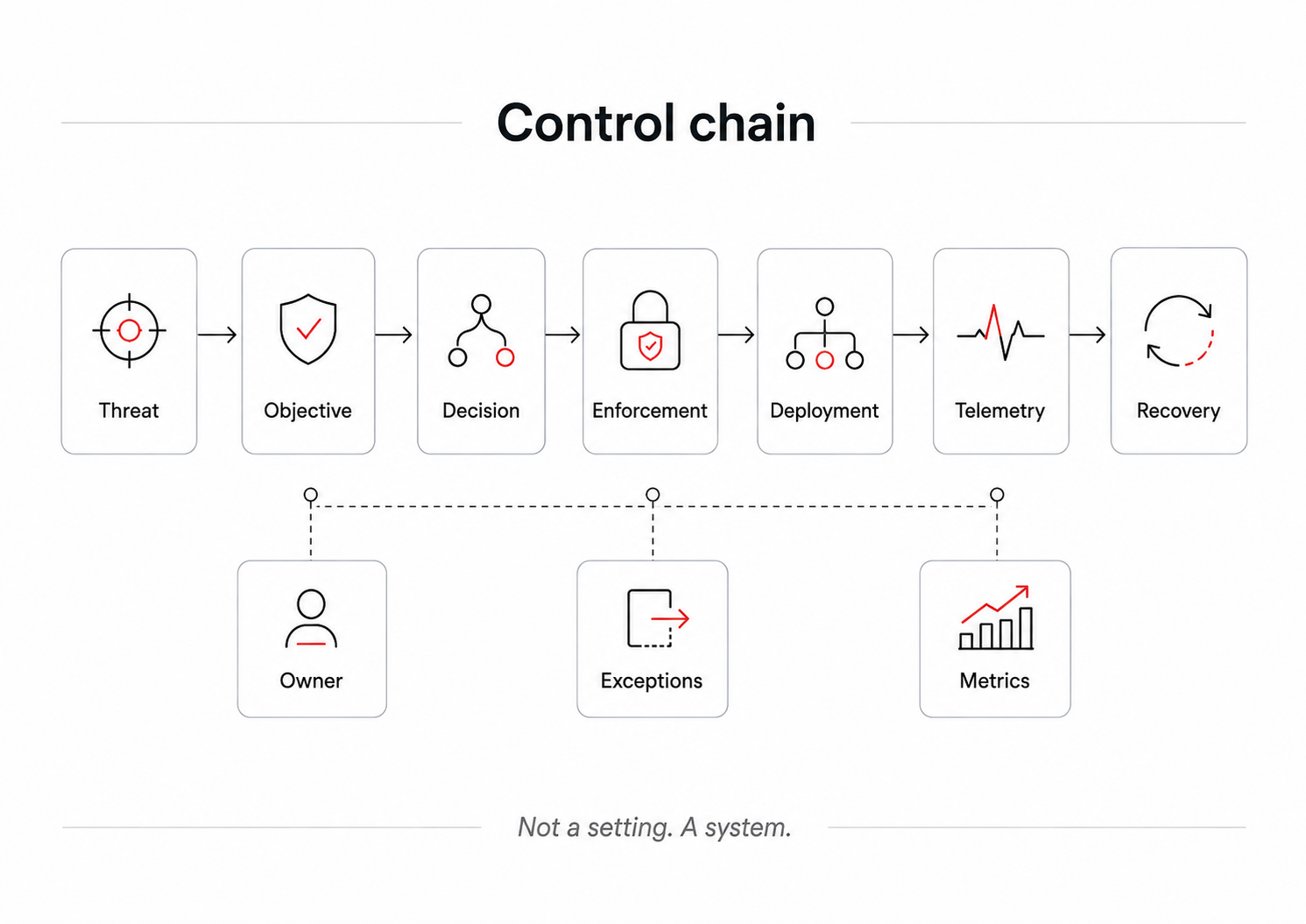
The control chain
| Component | What it must answer |
|---|---|
| Threat scenario | The behavior, condition or loss pathway the organization intends to reduce. |
| Security objective | The property that must remain true, such as only approved software may execute or only authorized identities may access tenant-scoped data. |
| Decision point | Where the system evaluates policy or context. |
| Enforcement point | Where the action is allowed, blocked, limited or transformed. |
| Distribution mechanism | How policy, configuration or code reaches the relevant population. |
| Telemetry path | How decisions, failures, bypasses and health states become observable. |
| Operational owner | Who is accountable for maintaining the capability and resolving conflict. |
| Exception system | How deviations are approved, compensated, reviewed and expired. |
| Validation method | How the organization demonstrates that the expected security property holds. |
| Recovery path | How the control can be rolled back, restored or operated in a degraded state. |
A control that cannot answer these questions is not necessarily useless. It may still reduce risk. But the organization does not yet understand it well enough to claim dependable assurance.
3. The twelve properties of an operable control
A practical way to challenge a control is to evaluate twelve properties. These are not a compliance checklist. They are the minimum questions required to determine whether the control survives contact with production reality.
1. Security objective
The control must protect a defined property, not merely satisfy a technology category. “Deploy EDR” is an activity. “Detect and contain unauthorized code execution on managed endpoints before lateral movement” is an objective.
2. Threat scenario
The organization should know which actor behavior, misuse case or failure condition the control is expected to change. Without a scenario, configuration decisions become arbitrary and effectiveness cannot be tested.
3. Decision and enforcement points
The control must be placed where the relevant action can actually be influenced. A policy evaluated after data has already left the trust boundary is not an effective prevention control.
4. Deployment mechanism
The organization needs a repeatable method to distribute policy and code, verify receipt and handle version divergence. Manual configuration does not scale into reliable assurance.
5. Coverage
Coverage requires the correct denominator. Ninety-eight percent endpoint coverage may be poor if the missing two percent contains build systems, domain controllers or privileged administrator workstations.
6. Telemetry
A control must produce evidence about decisions, health, bypass, errors and degraded states. Event logging without control context often proves activity but not correct enforcement.
7. Ownership
There must be a team that owns policy, technology, operational support, risk decisions and improvement. Shared responsibility without explicit decision rights often becomes no responsibility.
8. Exceptions
Exceptions must have rationale, owner, scope, compensating controls, expiry and review. Otherwise the exception layer gradually becomes the real security architecture.
9. Rollback and recovery
Security changes can disrupt production. A control that cannot be safely rolled back or recovered will either be deployed too slowly or bypassed under pressure.
10. Validation
The control must be tested against realistic failure and adversarial conditions. Configuration review confirms intent; control validation demonstrates behavior.
11. Maintenance
Threats, assets, dependencies and business workflows change. A control without maintenance degrades even when the technology remains installed.
12. Effectiveness metrics
Metrics must connect deployment and health to security outcomes. Counting rules, agents or policy assignments is not enough.
OPERATIONAL STANDARD
If a control cannot be deployed consistently, observed continuously, supported operationally, challenged realistically and recovered safely, its security value is conditional - and that condition should be visible to risk owners.
4. Five realistic failure scenarios
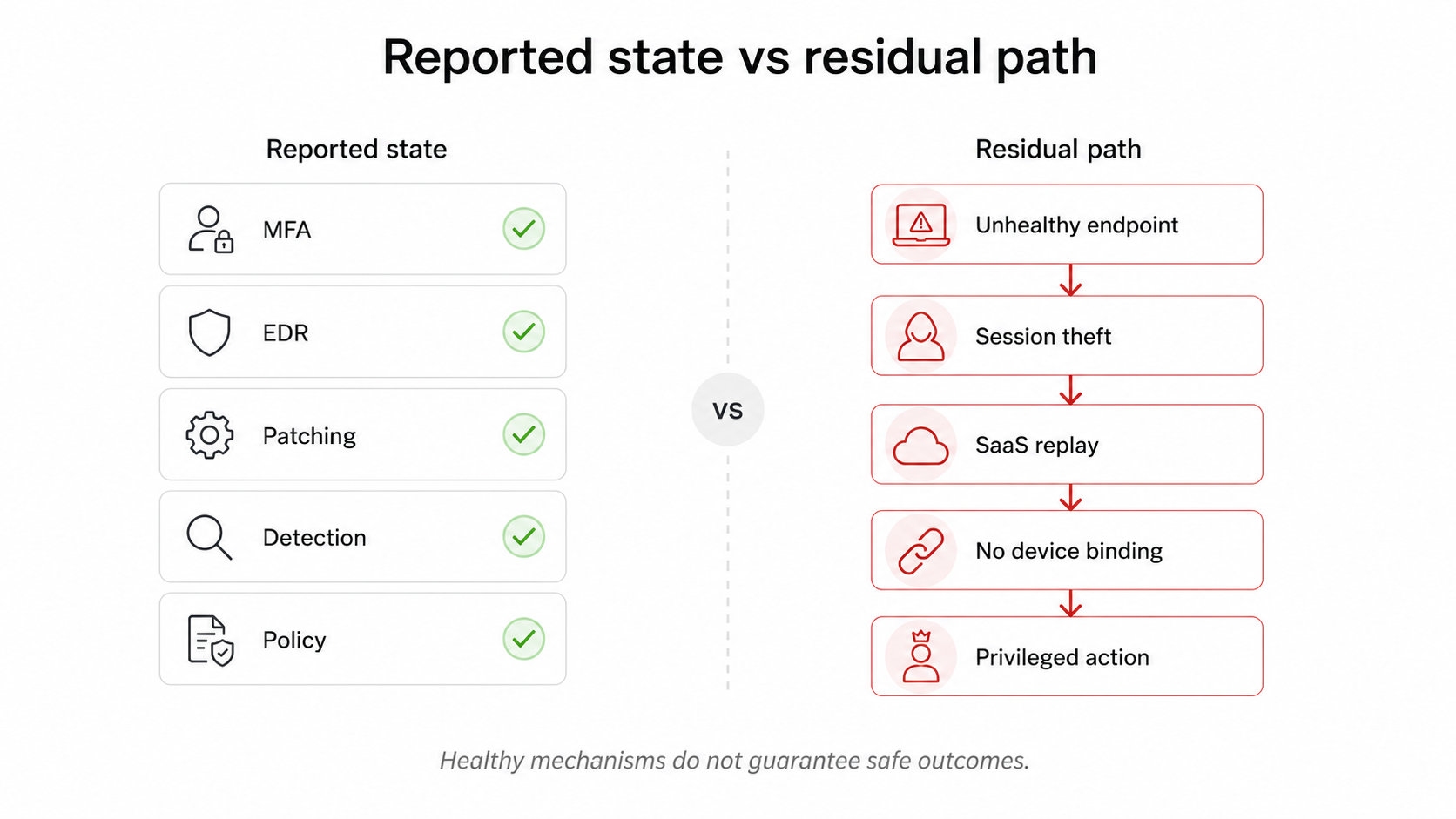
The following examples are intentionally realistic rather than spectacular. They show how controls fail in mature organizations without being completely absent. In each case, the dashboard can remain green while the loss pathway remains open.
Scenario 1: phishing-resistant MFA with a reusable session problem
| Scenario | The organization deploys FIDO2 authentication to privileged users and reports 96 percent adoption. |
|---|---|
| Risk | Account takeover of administrators could expose cloud control planes, identity infrastructure and sensitive business data. |
| Technical reality | Interactive authentication is strongly protected, but long-lived browser sessions are not device-bound, token revocation is inconsistent across SaaS applications, legacy administrative tooling remains exempt and help-desk recovery can reset authentication factors without equivalent assurance. |
| Executive view | The program reports that privileged users have phishing-resistant MFA. Leadership reasonably assumes credential phishing is no longer a material pathway to administrative compromise. |
| Failure mode | An infostealer captures session material from a managed but temporarily unhealthy endpoint. The attacker replays the session against a SaaS administration console that does not require device posture or step-up authentication for high-impact actions. |
| Security engineering lesson | Authentication strength is only one part of the control system. Session lifecycle, device trust, revocation, recovery and sensitive-action enforcement determine whether the intended risk reduction persists after login. |
The control did not fail because FIDO2 was weak. It failed because the security objective was framed too narrowly. “Require phishing-resistant authentication” became the implementation objective, while the real risk objective should have been “prevent stolen credentials or session material from enabling unauthorized privileged actions.”
Scenario 2: application allowlisting with an exception architecture
| Scenario | Application allowlisting is enabled across corporate endpoints to reduce execution of unapproved software. |
|---|---|
| Risk | Malware execution, unauthorized administration tools and user-installed software create a path to credential theft and lateral movement. |
| Technical reality | Policy is centrally distributed, but developer workstations receive broad path-based exclusions, emergency support accounts can disable enforcement, unsigned scripts are allowed through trusted interpreters and policy updates are paused for systems with compatibility issues. |
| Executive view | The organization can state that allowlisting is deployed on nearly all endpoints and may treat malware execution as substantially reduced. |
| Failure mode | An attacker uses a signed, trusted interpreter to execute code from a permitted development path. The endpoint agent reports healthy because the mechanism is functioning exactly as configured. |
| Security engineering lesson | Coverage of the enforcement engine is not equivalent to coverage of the security property. Exceptions, trusted execution paths and administrative bypasses must be included in the threat model and tested as part of the control. |
This is a common form of control failure: the mechanism operates correctly, but the policy model does not protect the intended invariant. Security cannot be measured only by whether the agent is installed or enforcement is enabled.
Scenario 3: a detection rule without a dependable telemetry contract
| Scenario | The SOC deploys a high-confidence detection for suspicious creation of cloud access keys followed by unusual API activity. |
|---|---|
| Risk | A compromised identity could create persistent credentials and operate outside normal authentication controls. |
| Technical reality | The analytic is sound, but audit logging is not enabled in every account, some high-volume events are sampled, timestamps are normalized inconsistently and the alert depends on enrichment from an ownership database that is often stale. |
| Executive view | The rule is present in the SIEM, mapped to an adversary technique and included in detection coverage reporting. |
| Failure mode | The attacker performs the activity in an account whose logs are delayed by a misconfigured forwarding pipeline. When the events arrive, missing ownership context routes the alert to a low-priority queue and no response occurs within the useful containment window. |
| Security engineering lesson | A detection is a control only when the telemetry source, schema, latency, enrichment, alert routing, analyst action and response path are engineered as one operating capability. |
Detection engineering often fails at the boundaries between teams. The security team owns the rule, a platform team owns the logs, another group owns asset data and the SOC owns response. Without an explicit telemetry contract and end-to-end owner, everyone can complete their task while the control remains unreliable.
Scenario 4: patch enforcement that excludes the systems with the greatest consequence
| Scenario | A critical vulnerability is actively exploited. The organization has an enterprise patch management platform and a seven-day SLA for critical issues. |
|---|---|
| Risk | Exploitation of exposed systems could enable initial access, operational disruption or compromise of sensitive data. |
| Technical reality | Most user endpoints can be patched automatically. Critical production systems require vendor certification, specialized testing windows and coordinated shutdown. Several assets are not represented correctly in the inventory because ownership is distributed across business units. |
| Executive view | The dashboard shows 93 percent remediation within SLA, supporting a conclusion that the vulnerability is under control. |
| Failure mode | The unpatched seven percent includes the externally reachable systems with the highest business impact. Compensating network controls are assumed but not validated, and temporary detection is not deployed consistently. |
| Security engineering lesson | Risk-weighted coverage matters more than population averages. Patch management is an operational risk system involving inventory, ownership, exposure, exploitability, change risk, compensating controls, validation and recovery. |
A useful executive question is not “What percentage is patched?” It is “Which loss scenarios remain possible after the current remediation state, and what evidence supports the compensating controls for the assets that cannot yet be patched?”
Scenario 5: service-account restriction without lifecycle ownership
| Scenario | The organization prohibits interactive use of service accounts and requires least privilege for machine identities. |
|---|---|
| Risk | Long-lived credentials and overprivileged non-human identities can provide durable access that is difficult to attribute and revoke. |
| Technical reality | New service accounts are created through a controlled workflow, but inherited accounts have unclear owners, credential rotation breaks legacy integrations, workload permissions are copied from broad templates and monitoring focuses on authentication failure rather than unexpected successful use. |
| Executive view | Policy, access review and secrets tooling create the appearance of a mature non-human identity program. |
| Failure mode | A dormant integration account with broad read permissions is reused from a new workload. Authentication succeeds, the credential has not expired and the activity is not considered anomalous because no expected-use baseline exists. |
| Security engineering lesson | Machine identity controls require ownership, intended-use modeling, credential lifecycle, authorization boundaries, behavioral telemetry and safe rotation. A policy without lifecycle engineering cannot govern a population that changes continuously. |
5. How controls degrade after successful deployment
The most dangerous controls are not always the ones that were never implemented. They are the controls that were implemented successfully, became trusted by leadership and then degraded without changing their label in the risk register.
Control degradation is usually gradual. It rarely appears as a single catastrophic failure. Instead, the control loses integrity through ordinary operational pressure:
-
New assets are created outside the deployment workflow.
-
A business-critical application requires a temporary exception that becomes permanent.
-
A vendor changes an API, breaking health or telemetry collection.
-
An agent remains installed but stops receiving policy updates.
-
A new identity path bypasses the original enforcement point.
-
A merger introduces systems that use different ownership and logging models.
-
A detection continues to execute after the underlying event schema changes.
-
A patch process optimizes for completion percentages rather than residual exposure.
-
A support team creates an emergency bypass and later incorporates it into routine operations.
-
The threat model changes, but the control objective does not.
Configuration drift is only one form of control drift
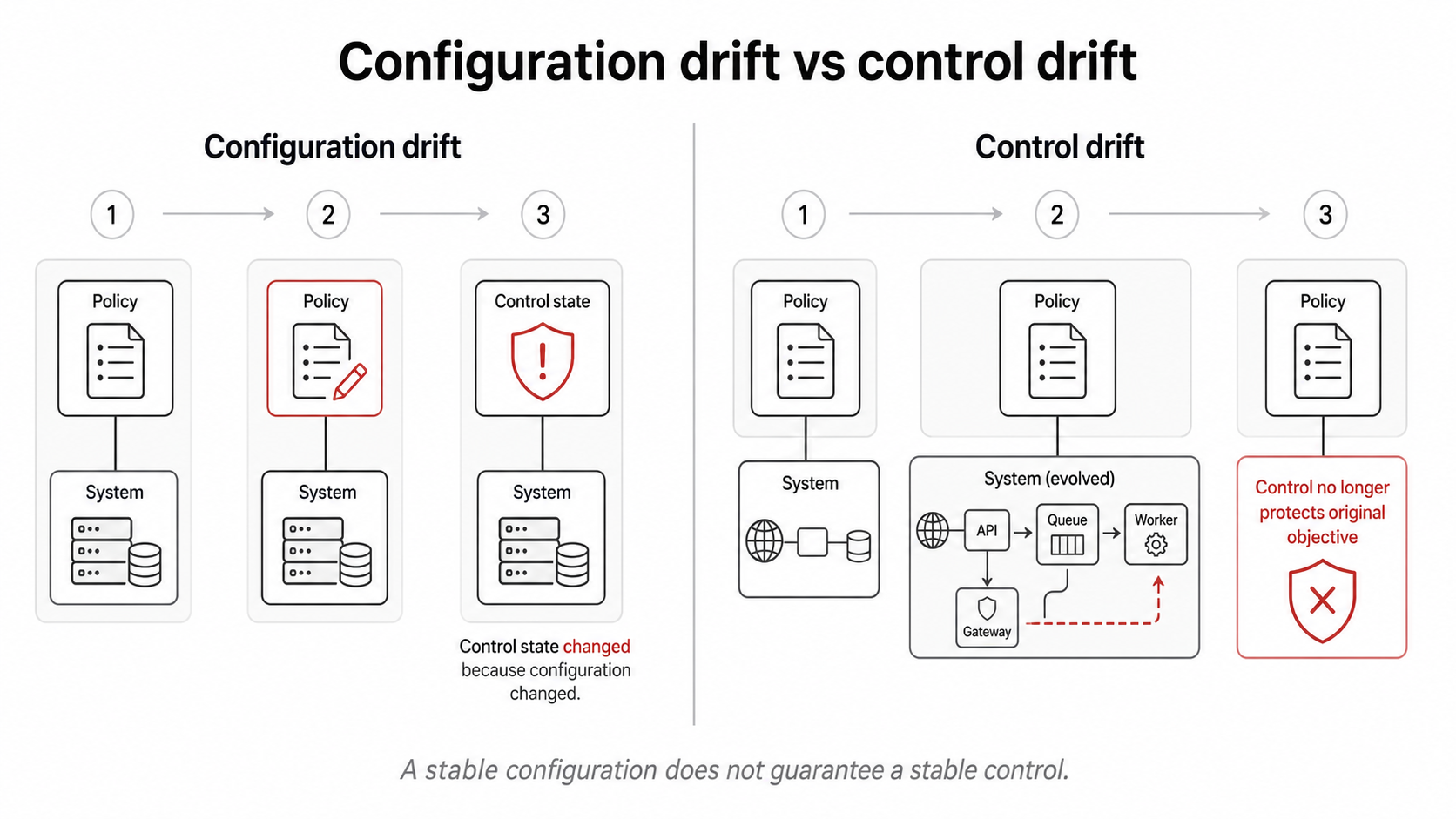
Configuration drift is visible when the deployed state diverges from a baseline. Control drift is broader. The configuration may remain identical while the environment around it changes enough to make the control ineffective.
A network rule may still block the same ports, but workloads have moved to a managed service that uses a different path. A detection may still match the same pattern, but the adversary now achieves the objective through an API. An authorization policy may be unchanged, but a new service begins trusting propagated claims that were never intended to cross that boundary.
This means continuous assurance cannot be limited to configuration compliance. It must evaluate whether the security objective still holds in the current architecture and threat environment.
Security debt accumulates in the exception layer
Exceptions are necessary. Security controls interact with production, and production contains legacy systems, specialized workflows, regulatory constraints, safety requirements and time-sensitive business needs. The problem is not the existence of exceptions. The problem is treating them as administrative records rather than architectural changes.
Every exception modifies the effective policy. A broad exemption for developers, a permanent bypass for a vendor, a service account excluded from rotation or a system removed from patch enforcement creates a new attack surface. If the organization does not model that surface, the documented control and the real control diverge.
EXCEPTION PRINCIPLE
A permanent exception is not an exception. It is an undocumented policy decision with an unmeasured risk consequence.
6. Failure modes, degraded states and recovery
Traditional control design often asks what the control should do when everything is healthy. Security engineering must also ask what the system does when dependencies fail, data becomes stale, policy cannot be retrieved or enforcement creates unacceptable business impact.
Fail-open and fail-closed are not binary design choices
The familiar question - should the control fail open or fail closed? - is useful but incomplete. Real systems often need multiple degraded states based on transaction risk, identity assurance, resource sensitivity, dependency health and business criticality.
An authorization service might allow low-risk read operations from cached policy while blocking privilege changes. An endpoint control might preserve previously approved software while preventing new executions. A data access gateway might restrict bulk export but allow limited operational queries. A detection pipeline might continue collecting raw events while enrichment is unavailable, preserving evidence for later processing.
The mature question is therefore not simply whether a control should fail open or closed. It is:
-
Which security properties must remain true during dependency failure?
-
Which actions can continue safely under reduced confidence?
-
How is the degraded state signaled to operators and risk owners?
-
How long can the degraded state persist before business or security risk becomes unacceptable?
-
What evidence is retained for later investigation?
-
How is normal operation restored without creating a new bypass?
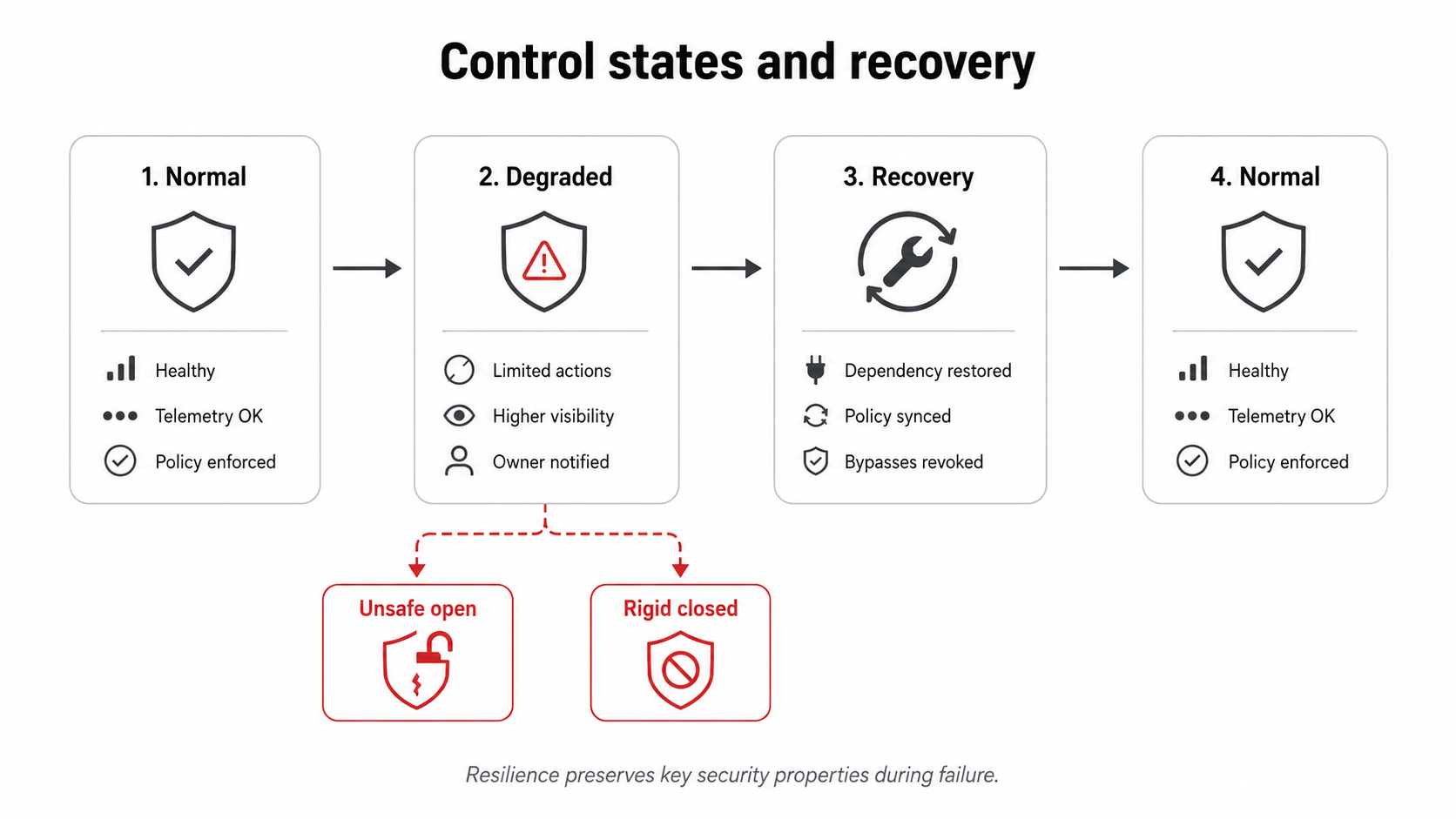
Rollback is part of the security design
Security teams sometimes treat rollback as a delivery concern rather than a control property. This creates a predictable outcome: high-impact security changes are delayed because engineering teams do not trust the recovery path, or emergency bypasses are created outside the design when problems occur.
A safe rollback does not mean returning blindly to the previous vulnerable state. It may involve staged policies, feature flags, limited-scope enforcement, compensating monitoring, temporary segmentation or restricted operation. The objective is to preserve both business continuity and an explicit understanding of residual risk.
7. Metrics that distinguish presence from effectiveness
A control dashboard can be accurate and still produce the wrong executive conclusion. This usually happens when the metric describes deployment activity but is interpreted as evidence of risk reduction.
| Metric layer | Question | Example |
|---|---|---|
| Deployment | How much of the intended population has received the mechanism or policy? | Percentage of eligible endpoints with the agent installed. |
| Coverage | How much of the relevant risk surface is actually subject to the control? | Percentage of privileged authentication paths requiring phishing-resistant MFA. |
| Health | Is the control currently able to make and enforce decisions? | Percentage of agents reporting current policy and telemetry within the expected interval. |
| Policy integrity | Does the configured logic preserve the intended security property? | Percentage of high-risk exception paths tested against the expected invariant. |
| Efficacy | Does the control change the outcome of realistic threat scenarios? | Proportion of adversarial test cases prevented, detected or contained within the required window. |
| Friction | What operational cost or bypass pressure does the control create? | Exception requests, user bypass attempts, deployment failures and support burden. |
| Recovery | Can the organization restore the control after failure or change? | Time to detect degradation and return to the defined operating state. |
| Residual risk | Which material scenarios remain possible despite the control? | Attack paths that remain viable after current coverage, exceptions and compensating controls. |
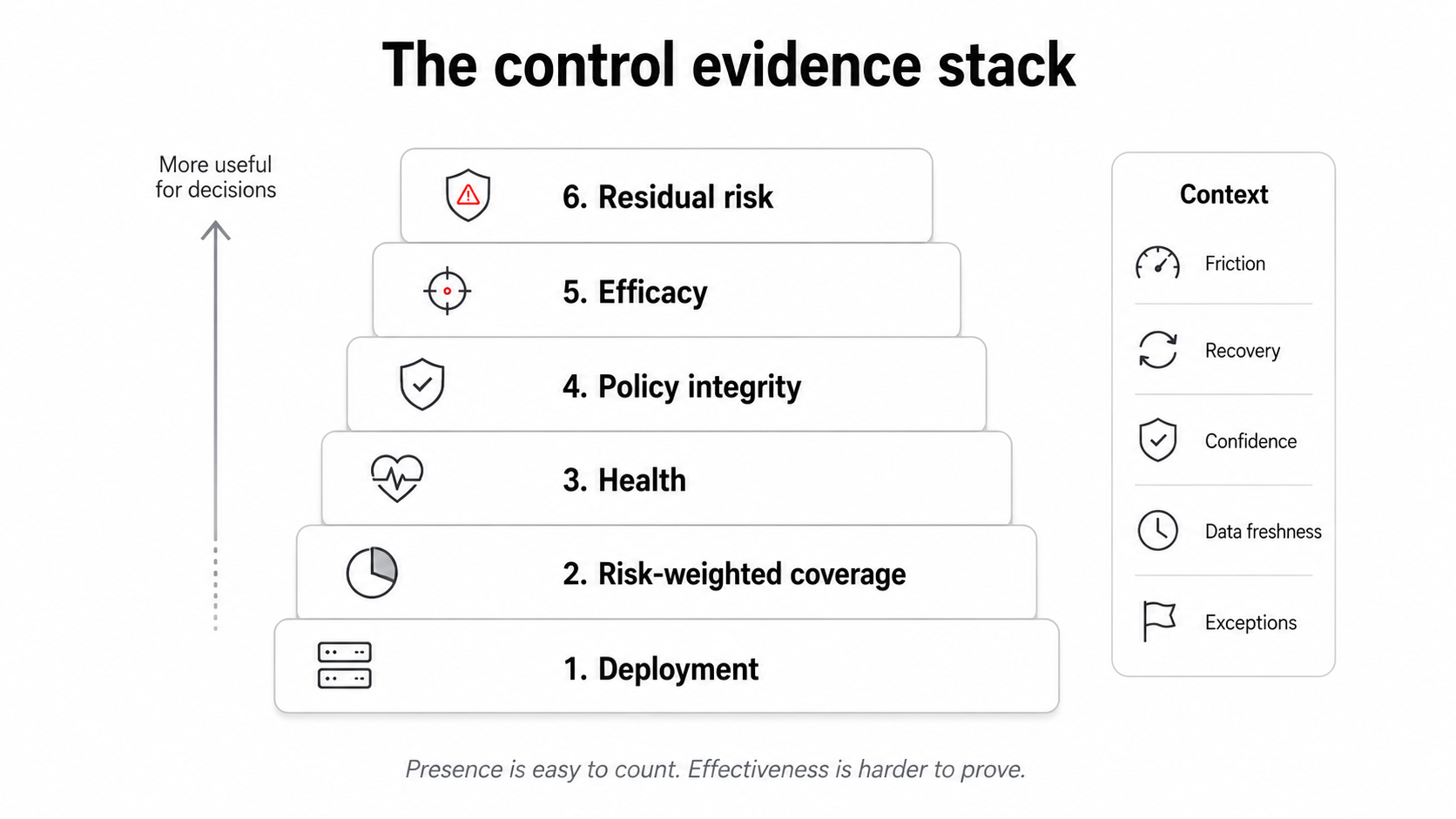
The layers should not be collapsed. A control can have high deployment and low coverage, high coverage and poor health, strong health and weak policy integrity, or correct policy with low efficacy against the current threat scenario.
This distinction matters to a CISO because investment decisions depend on understanding where the capability is failing. Buying additional licenses will not fix a policy model. Increasing staffing will not fix missing telemetry. Tightening enforcement may reduce bypass but create operational disruption if the deployment and rollback system is immature.
Good metrics expose uncertainty
Security metrics should not only show a number. They should show the denominator, data freshness, excluded populations, exception scope and confidence in the measurement. A precise percentage calculated from incomplete inventory is not reliable assurance.
A useful control report might state: “Phishing-resistant authentication covers 91 percent of privileged interactive access. The remaining nine percent includes two legacy administrative systems and four emergency accounts. Session replay resistance has not been validated across three SaaS applications, and device-bound enforcement is unavailable for one critical workflow.”
This statement is less comfortable than “MFA coverage: 98 percent,” but it is far more useful for risk ownership and prioritization.
8. Ownership, exceptions and the hidden operating model
Most control failures are not purely technical. They occur because the operating model does not match the architecture of the control.
A control can cross multiple organizational boundaries: identity manages policy, platform engineering manages deployment, infrastructure manages assets, security operations manages alerts, application teams manage exceptions, help desk handles user recovery and risk management approves residual exposure. Without explicit decision rights, each team can optimize its part while the end-to-end capability fails.
Ownership must include decision authority
Naming a control owner is not enough if that owner cannot change policy, require remediation, reject exceptions, prioritize engineering work or escalate material risk. Accountability without authority creates reporting, not control.
The effective owner should be able to answer:
-
What security outcome is this control responsible for?
-
Which systems and populations are in scope?
-
What dependencies can cause loss of effectiveness?
-
Who can approve an exception, and based on which risk information?
-
Which metrics indicate degradation?
-
What is the response when the control is unhealthy?
-
How is effectiveness validated independently?
-
What investment is required to close the remaining material gaps?
Exception governance is security architecture governance
Exceptions should be designed with the same rigor as the primary control. At minimum, an exception should include scope, reason, risk scenario, business owner, technical owner, compensating control, telemetry, expiry, review trigger and rollback condition.
The most important field is often missing: what new loss pathway becomes possible because the exception exists? Without that statement, an approval process can become an administrative ritual disconnected from risk.
9. Validation: from assurance to adversarial evidence
Security programs often validate controls through configuration review, policy attestation, audit sampling or vendor health dashboards. These methods provide useful evidence, but they do not establish that the control changes adversarial outcomes.
Control validation should operate at several levels:
Design validation
Does the architecture place the control at the correct decision and enforcement points? Are failure modes and bypasses represented in the threat model?
Configuration validation
Does the deployed policy match the approved design? Are versions, dependencies and exceptions known?
Functional validation
Does the control permit expected activity and block or detect defined negative cases?
Adversarial validation
Can realistic attacker behavior bypass, evade or exploit assumptions in the control?
Operational validation
Can teams detect degradation, investigate alerts, execute containment and recover the control within required time?
Regression validation
Does the security property remain true after application changes, platform updates and policy modifications?
Red Team should test the control system, not only the target system
A mature offensive assessment does more than prove compromise. It identifies which control was expected to change the attack path, whether the activity was observable, what prevented timely response, how exceptions affected the result and whether the recommended fix can be validated continuously.
This reframes the output from a list of vulnerabilities to evidence about the organization’s security capabilities. The most valuable conclusion may not be that an attacker reached a critical asset. It may be that an identity control protected initial access but failed at session recovery, that endpoint prevention worked but telemetry did not reach the SOC, or that a cloud guardrail blocked the direct path while a vendor integration created an equivalent authority path.
ASSURANCE PRINCIPLE
A control should not be considered effective because it passed an audit or because no incident has exposed it yet. It should be considered effective when its security objective survives realistic challenge and its failure is visible, owned and recoverable.
10. The CISO control reality test
A CISO does not need to inspect every technical configuration. But the executive team should be able to challenge whether critical controls are dependable systems rather than reported intentions.
For each control that protects a material business capability, ask the following questions:
-
What specific loss scenario is this control expected to reduce?
-
What security property must remain true for the control to succeed?
-
Where are the decision and enforcement points?
-
What percentage of the relevant risk surface is covered - not merely licensed or enrolled?
-
Which high-impact assets, identities or workflows remain outside the control?
-
How does the organization know when the control is unhealthy, stale, bypassed or operating in a degraded state?
-
Who owns the end-to-end capability and has authority to change policy or escalate risk?
-
How many exceptions exist, what exposure do they create and when do they expire?
-
What happens when the control or one of its dependencies fails?
-
Can the control be rolled back or recovered without creating an unmanaged bypass?
-
When was it last tested against realistic adversarial behavior?
-
What did the last validation show about prevention, detection and response?
-
Which metrics demonstrate effectiveness rather than deployment activity?
-
What material residual risk remains after the current control state?
-
What evidence would cause leadership to change investment, priority or risk acceptance?
A simple maturity interpretation
| Maturity | Meaning |
|---|---|
| Level 0 - Claimed | The control is described in policy or architecture, but there is little evidence of implementation. |
| Level 1 - Deployed | The mechanism exists in production, but coverage, health and exceptions are poorly understood. |
| Level 2 - Managed | Ownership, deployment, monitoring and support processes exist; known gaps are tracked. |
| Level 3 - Validated | The control is tested functionally and adversarially against defined threat scenarios. |
| Level 4 - Resilient | Failure modes, degraded states, recovery and regression are engineered and measured. |
| Level 5 - Adaptive | Threat intelligence, incidents, architecture changes and metrics continuously change the control design and investment decisions. |
The objective is not to make every control Level 5. That would be economically irrational. The objective is to align maturity with business consequence, threat relevance and dependency. A control protecting a low-impact workflow may be adequately managed at Level 2. A control protecting identity infrastructure, payment authorization, patient safety or production continuity may require validated and resilient operation.
11. A more demanding definition of security posture
Security posture is often represented as the sum of tools, policies, certifications, vulnerabilities and projects. A more useful definition is the set of security properties the organization can maintain under normal operation, change, failure and adversarial pressure.
This definition is more demanding because it prevents a program from claiming strength based solely on presence. It asks whether the organization can sustain the control across time, architecture changes, exceptions, incidents and business pressure.
It also changes how security investments are discussed. The question becomes less about whether the organization needs another product and more about which part of the control system is failing:
-
The threat scenario may be poorly defined.
-
The policy may not protect the intended invariant.
-
The enforcement point may be bypassable.
-
Deployment may not reach the assets that matter.
-
Telemetry may be incomplete or too slow.
-
Ownership may be fragmented.
-
Exceptions may have become the dominant architecture.
-
Recovery may be too risky to test.
-
Metrics may report activity rather than outcome.
-
Validation may be limited to configuration and audit evidence.
For the CISO, this creates a sharper risk conversation. A control is no longer accepted as a green box in an architecture diagram. It becomes a claim about how the organization will behave when a specific loss scenario begins to unfold. That claim requires evidence.
For the engineer, it creates a broader design responsibility. Security is not complete when the rule is written or the feature is enabled. The work includes rollout, telemetry, support, failure, exception, recovery and measurement.
For the offensive team, it creates a more valuable testing objective. The goal is not only to discover that an attack path exists, but to explain which control assumptions failed, whether the failure was visible and how the organization can prove the path remains closed after remediation.
For risk leaders, it creates a more honest representation of residual exposure. Controls are not binary. Their value is conditional on coverage, health, policy integrity, operational capacity and the threat scenarios against which they have been validated.
CLOSING PROPOSITION
The organization does not have a control because a policy says it should exist, a tool says it is enabled or a project says it was delivered. It has a control when the intended security property is continuously enforced, observable, owned, testable and recoverable in the systems that matter.
Final thoughts
The most uncomfortable control review is often the most useful one. It does not ask whether the organization has MFA, EDR, logging, patching, allowlisting or access governance. It asks which concrete loss scenarios those controls can change today, under current architecture and operating conditions, and what evidence supports that confidence.
A CISO who asks this question may discover fewer controls than the program inventory suggests. That is not necessarily a failure. It is the beginning of a more credible security strategy - one that distinguishes intention from capability, configuration from operation and presence from effectiveness.
Security controls should reduce uncertainty about how the organization will behave under pressure. When a control cannot be deployed consistently, observed continuously, maintained responsibly, challenged realistically or recovered safely, the uncertainty remains. The system may still be safer than before, but leadership should not confuse improvement with assurance.
A security control becomes real when it survives the conditions that make security difficult: scale, change, failure, exceptions, adversaries and business trade-offs. Everything before that is a design promise.