
Beyond Authentication: Where Real Incident Impact Begins
In offensive security, it is still common to treat authentication as the main security boundary or turning point of an asset or system.
If the login holds, the system appears reasonably protected.
If credentials are strong, MFA exists, and session handling looks acceptable, many assessments quickly move on to traditional vulnerability classes: injections, exposed panels, misconfigurations, outdated components, missing headers, CVEs, scanners, and isolated findings.
All of that still matters.
But in real incidents, especially in modern enterprise environments, the most important question is not always whether an attacker can authenticate.
The more important question is often what a valid identity can do once the system accepts it.
That is where authorization becomes the real boundary of impact.
The Incident Does Not End at Access
Many security assessments still treat access as the main offensive milestone:
- obtaining credentials
- bypassing a login
- stealing a session
- compromising an account
- reaching an internal panel
From the perspective of a real attacker, that is only the beginning.
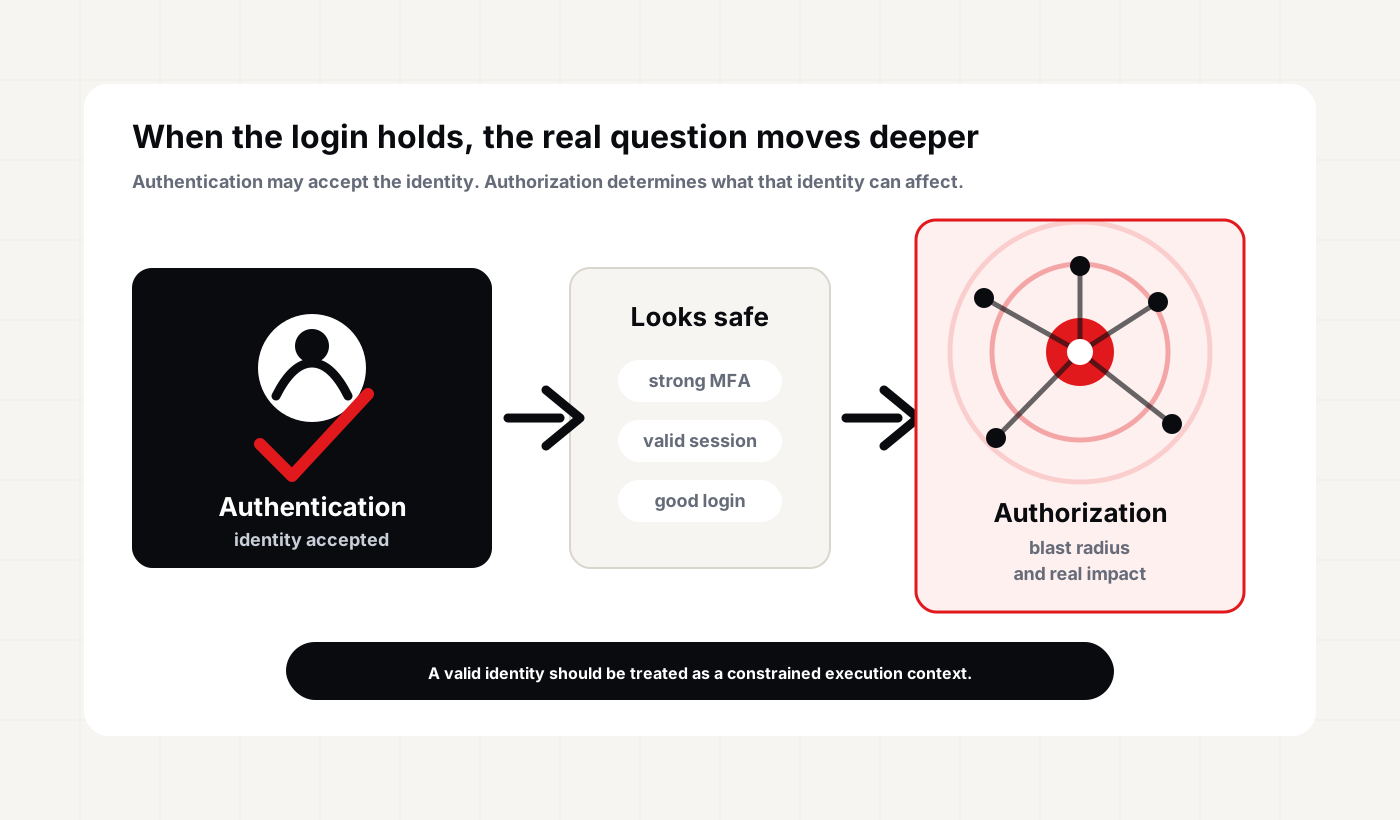
A valid identity is not the final objective.
It is an execution context.
Once the system accepts an identity, the relevant questions change:
- What resources can it reach?
- What actions can it perform?
- What trust relationships does it inherit?
- What services will act on its behalf?
- What data boundaries can it cross?
- What business workflows can it trigger?
- What controls limit its blast radius?
- What telemetry exists when that identity behaves abnormally?
This is where many systems fail, because the people who design systems, implement services and technologies, develop software, defend environments, or assess them offensively often do not consider all of these points.
They correctly authenticate the user, service, or application making the request, but fail to properly constrain the consequences of legitimate access.
We rely too heavily on authentication.
Authentication Answers Identity. Authorization Defines Blast Radius.
Authentication answers:
Who is making the request?
Authorization answers:
What can this identity do, to which resource, under which context, through which path, and with what downstream effects?
That last part is often ignored.
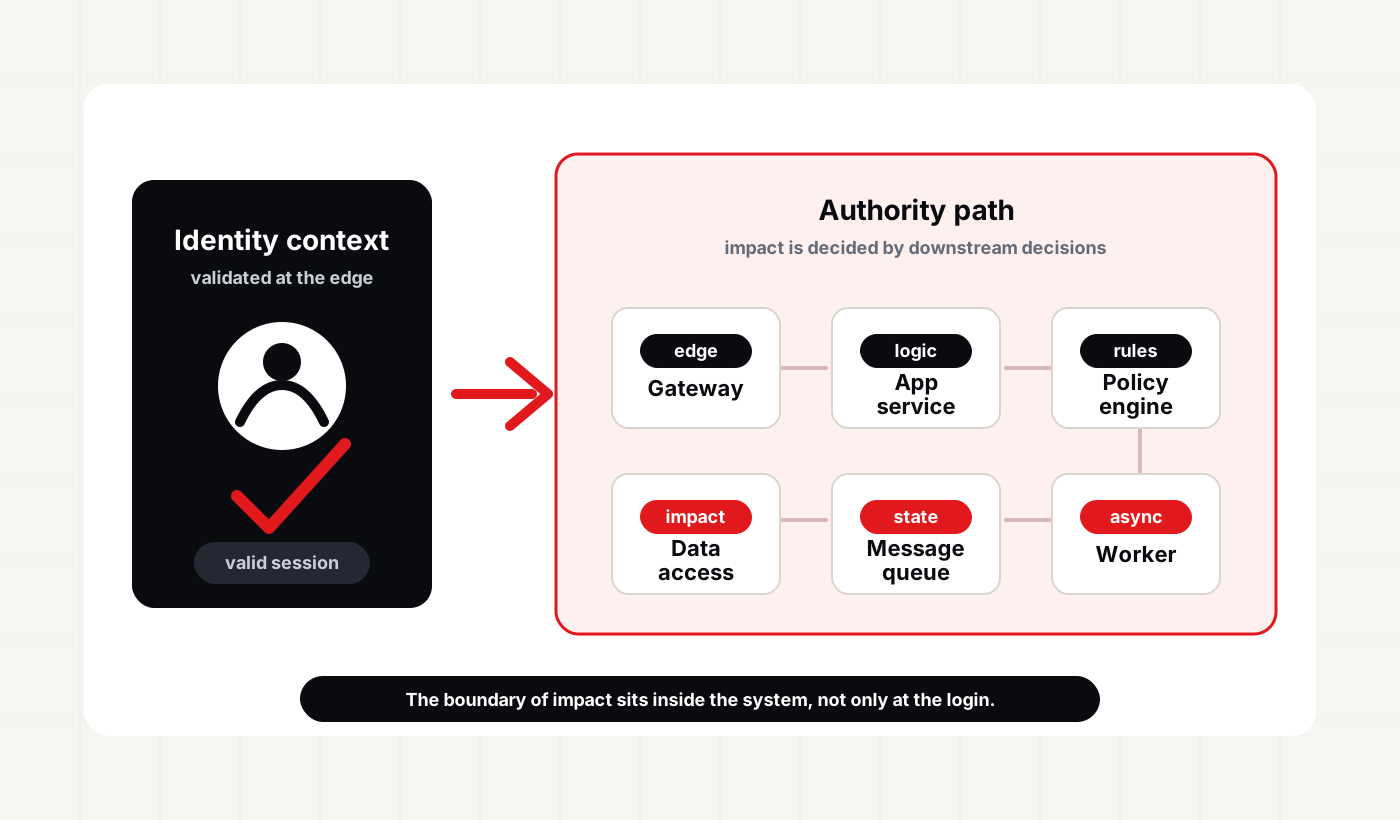
In real systems, authorization is not a single check. It is a chain of decisions distributed across components:
- API gateways
- application services
- background workers
- internal APIs
- databases
- message queues
- cloud services
- third-party integrations
- service accounts
- policy engines
- caching layers
A user may be authenticated at the perimeter of the system, but the real impact of that session is determined much deeper inside.
The mistake is assuming that authentication creates a safe context.
It does not.
Authentication creates an identity context.
Authorization must decide how far that context is allowed to propagate and what authority it can exercise.
The Problem With Login-Centric Offensive Testing
A large part of offensive security learning still conditions people to think in terms of broken entry points.
-
Find the login.
-
Ask ChatGPT or Claude.
-
Try common payloads.
-
Look for SQL injection.
-
Run the scanner: Acunetix, Invicti, Nessus, or any similar tool.
-
Find the CVE.
-
Exploit the machine.
-
Move to the next target.
This is a worrying approach that I still see at scale in LATAM.
It can be useful for learning fundamentals or performing generic reviews, but it builds a shallow model of how real systems fail.
Labs, vulnerable machines, and intentionally broken environments often teach a linear view of compromise:
reconnaissance → exploitation → shell → privilege escalation
Real enterprise systems are rarely linear.
They are composed of identities, services, workflows, policies, roles, data boundaries, asynchronous processes, integrations, and implicit trust assumptions.
A SaaS platform, a banking workflow, a cloud environment, or an enterprise API is not simply a set of endpoints.
It is a system of delegated authority.
If a review does not model that authority, it will probably miss the most important risks.
Authorization Failures Are Not Always Missing Checks
A common idea is that authorization failures happen only when someone forgot to add an access control check.
That happens, but it is not the whole story.
In more mature systems, the check may exist and still be wrong.
The system may be validating:
- the wrong resource
- the wrong tenant
- the wrong action
- the wrong role
- the wrong token audience
- the wrong point in time
- the wrong service identity
- the wrong relationship in the graph
That is why many authorization failures are not simply the absence of authorization.
They are authorization decisions made with incomplete or incorrect context.
A service may enforce a policy.
The policy may evaluate correctly.
The decision may still be unsafe because the context used to make that decision was wrong.
That is the part automated testing usually misses.
Valid Credentials Are Not the Complete Threat Model. Misused Authority Is.
In many incidents, attackers do not need to break authentication.
They use:
- leaked credentials
- valid sessions
- stolen cookies
- OAuth tokens
- refresh tokens
- API keys
- service accounts
- overprivileged roles
- compromised third-party integrations
- internal accounts
- cloud workload identities
From a defensive perspective, this changes the threat model.
The question is not only:
Can an attacker get in?
The better question is:
If an attacker obtains a valid identity, how much authority can they exercise before being stopped?
That question is much harder.
It forces a review of:
- least privilege
- tenant isolation
- ownership validation
- permission inheritance
- scope design
- session revocation
- service-to-service trust
- auditability
- detection coverage
- blast radius reduction
This is the difference between testing authentication and evaluating resilience.
The Authorization Surface Is Larger Than the API Surface
Security testing often starts by mapping endpoints.
That is necessary, but insufficient.
The authorization surface includes every place where authority is created, transformed, delegated, cached, assumed, or enforced.
That includes:
- who issued the token
- who validates it
- who trusts that validation
- where scopes are interpreted
- where roles are mapped
- where ownership is checked
- where tenant boundaries are enforced
- where service accounts are used
- where asynchronous jobs continue execution
- where permissions are cached
- where resource relationships are resolved
- where policy decisions are logged
A system can have a small API surface and a large authorization surface.
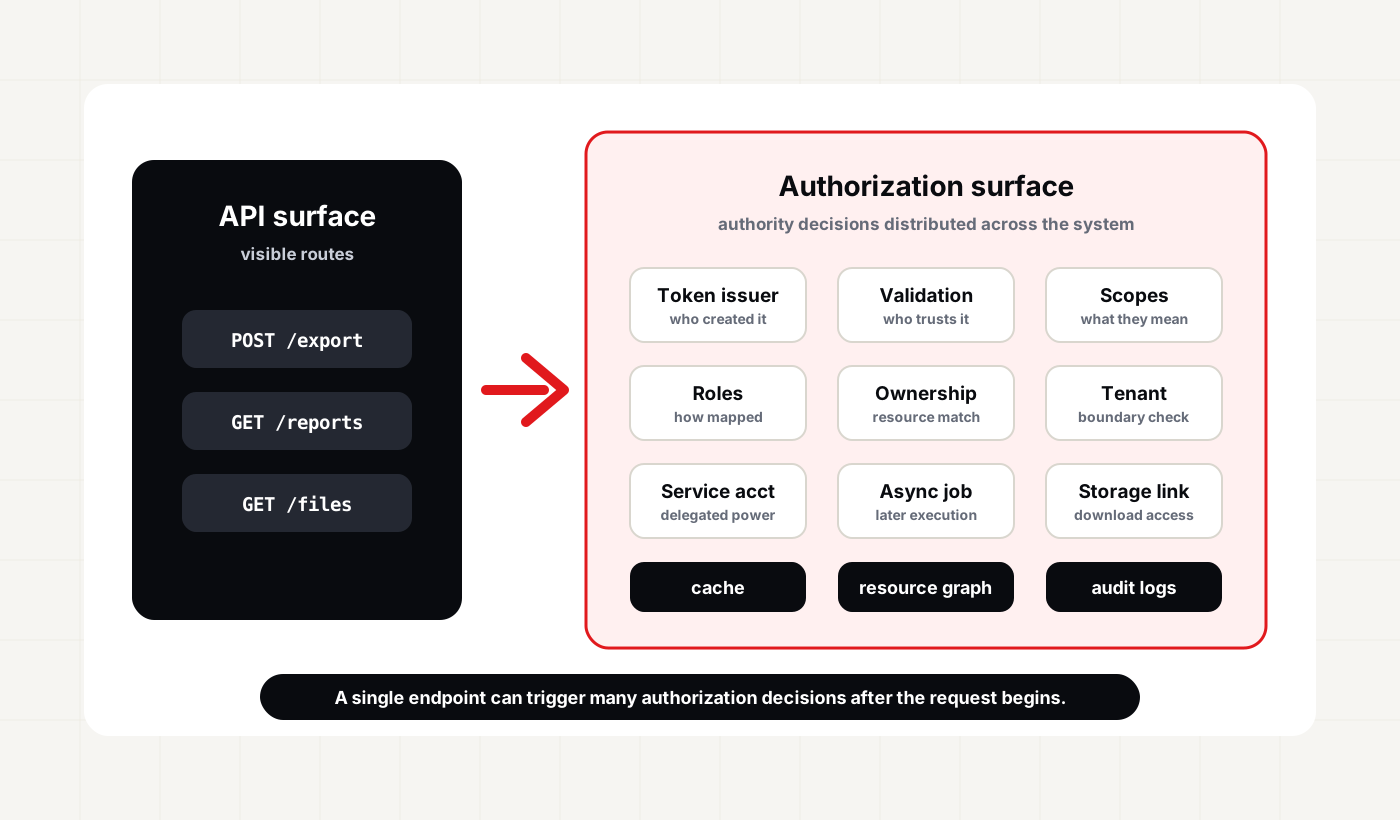
This is especially true in distributed environments, where a single request can trigger multiple internal actions.
For example:
A user requests an export.
The API validates the request.
A job is queued.
A worker processes it later.
The worker reads data from storage.
A file is generated.
A signed URL is created.
A notification is sent.
Where was authorization enforced?
At request time?
At job execution time?
At data access time?
At file generation time?
At download time?
If the answer is “only at the beginning,” the system may be relying on stale authorization.
Real Incidents Exploit Chains of Trust, Not Just Bugs
Treating vulnerabilities in isolation is another common mistake.
A weak permission may look medium.
A leaked credential may look contained.
A missing tenant validation may look like a single endpoint issue.
A permissive service account may look like an operationally convenient decision.
A missing detection may look like only a monitoring gap.
But attackers do not experience these elements as separate findings.
They experience them as a path.
Example:
- A valid account is compromised.
- The account has broader access than expected.
- An API validates authentication, but not resource ownership.
- An export job runs with service-level privileges.
- Generated files are stored in a location accessible through predictable or long-lived links.
- Logs record the job execution, but do not correctly preserve the original user context.
- Detection sees normal service behavior, not abuse.
None of these steps require a classic exploit.
The incident emerges from the composition of legitimate behaviors.
That is why authorization must be reviewed as a system property, not as an isolated property of an endpoint.
Access Control Is Also a Detection Problem
Authorization is usually discussed as prevention.
Allow or deny.
But in real incidents, access control is also a detection and response problem.
A mature system should not only ask:
Should this request be allowed?
It should also ask:
Is this access pattern expected for this identity?
Examples:
- A user suddenly accesses hundreds of records.
- A service account starts reading data outside its normal domain.
- A refresh token is used from a new geographic location.
- A low-privilege account triggers high-impact workflows.
- A tenant-scoped user repeatedly probes neighboring resources.
- An internal service calls an API route it normally never uses.
- A token is used against an audience it was not issued for.
These are not always authentication failures.
They are signals of authorization abuse.
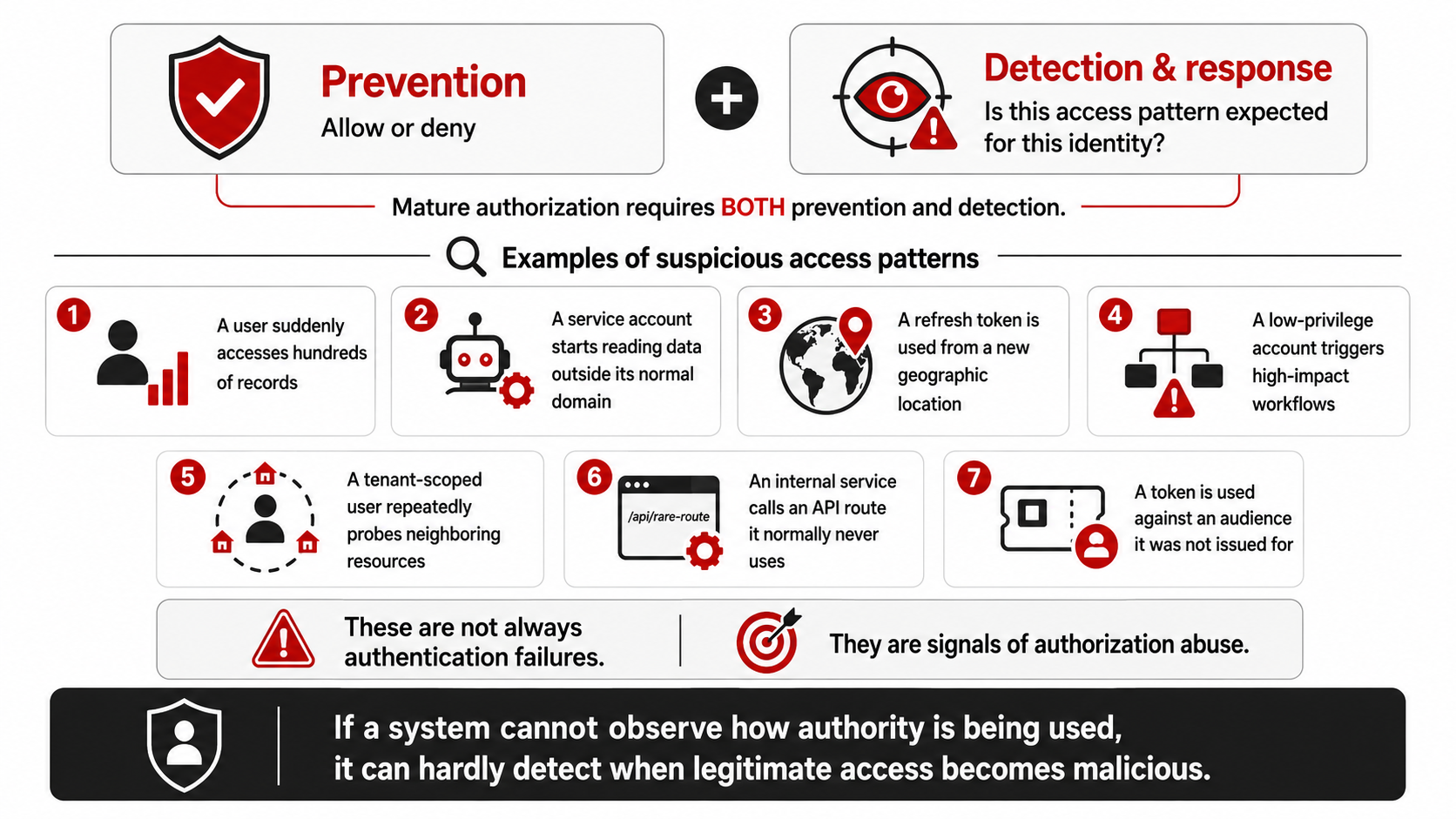
If a system cannot observe how authority is being used, it can hardly detect when legitimate access becomes malicious.
That is one reason why offensive security, CTI, detection engineering, and risk management should not operate as isolated disciplines.
The Question of a Mature Review
A shallow review asks:
Can I bypass the login?
A better review asks:
Can I access something I should not?
A mature review asks:
How does this system create, propagate, constrain, observe, and revoke authority?
That question changes everything.
It forces you to inspect:
- identity sources
- token claims
- session lifetime
- refresh token behavior
- revocation paths
- resource ownership
- tenant boundaries
- role mapping
- relationship models
- enforcement points
- service identities
- trust boundaries
- asynchronous workflows
- traceability and auditability
- detection logic
- failure modes
This is where senior reviews differ from tool-driven testing.
The objective is not to accumulate findings.
The objective is to understand how the system fails under adversarial use.
Authentication Failure vs Authorization Failure in Incident Analysis
When analyzing an incident, it can be useful to separate three layers.
First: identity acquisition.
How did the attacker obtain a valid identity?
Examples:
- phishing
- credential stuffing
- infostealer logs
- exposed API keys
- session theft
- OAuth consent abuse
- compromised service account
Second: authority expansion.
What could that identity do?
Examples:
- access sensitive records
- enumerate tenants
- invoke privileged workflows
- assume roles
- create tokens
- export data
- access internal APIs
- trigger background processes
Third: impact realization.
How did the system allow that authority to become business impact?
Examples:
- data exfiltration
- account takeover
- fraudulent transactions
- privilege escalation
- persistence
- operational disruption
- lateral movement
- control evasion
Many reports focus too much on the first layer.
But the second and third layers often explain why the incident became serious.
The attacker may have entered through authentication.
But the damage was defined by authorization.
Why This Matters for Red Team and Security Engineering
A Red Team that only proves access is not enough.
A senior security function should be able to answer:
- What assumptions enabled the attack path?
- Which permissions amplified the impact?
- Which trust boundary failed?
- Which authorization decision was too broad?
- Which detection should have triggered?
- Which control would have reduced the blast radius?
- Which architectural change prevents recurrence?
That is the value of offensive security when it matures beyond exploitation.
It becomes a way to test the organization’s trust model.
Simulated Scenario
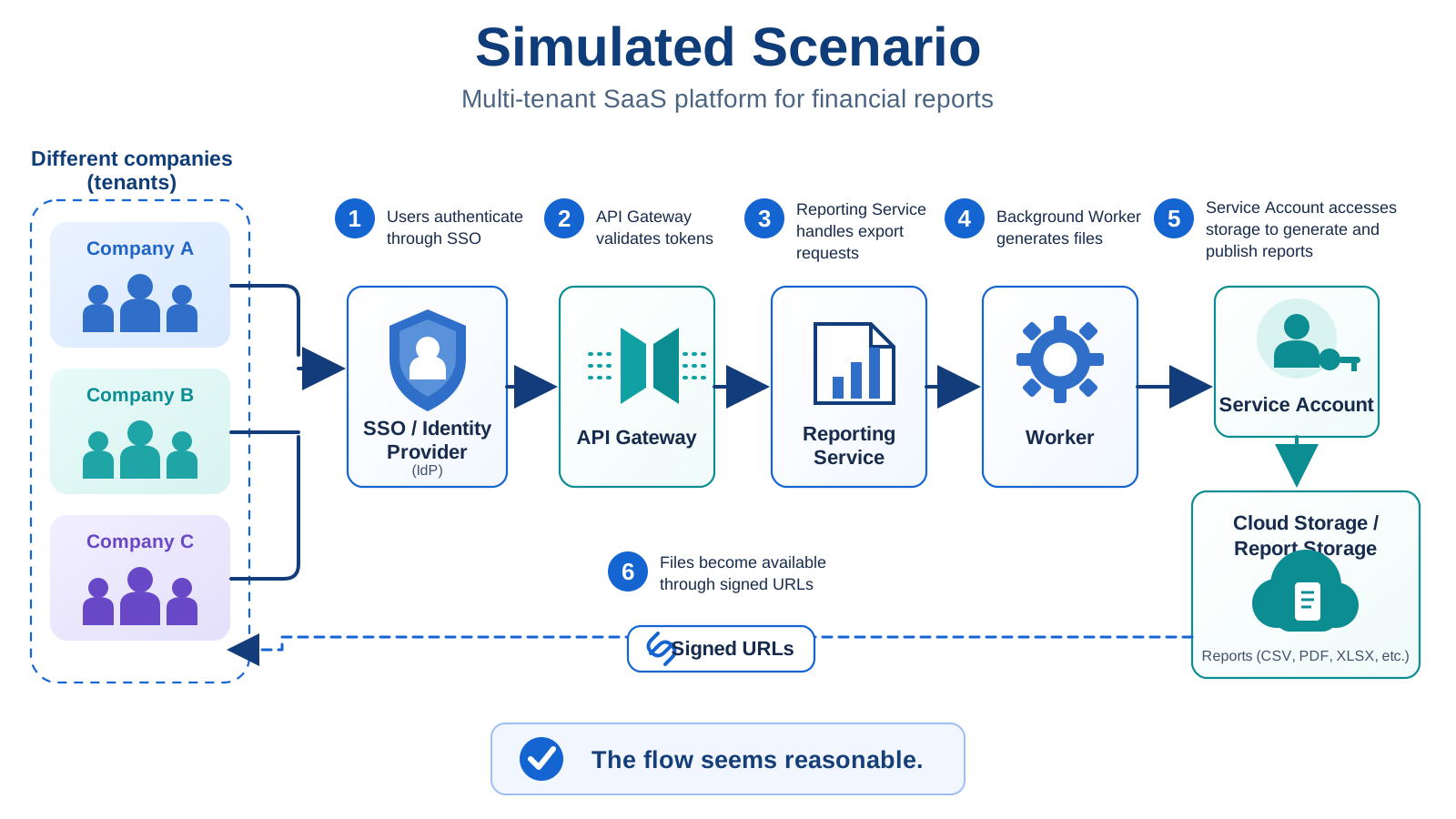
Imagine a multi-tenant SaaS platform used by different companies to manage financial reports.
The architecture is relatively common:
- users authenticate through SSO
- an API Gateway validates tokens
- a reporting service handles export requests
- a worker generates files in the background
- files become available through signed URLs
- a service account accesses storage to generate and publish reports
The flow seems reasonable.
An authenticated user requests the export of a report.
The API Gateway validates that the token is valid.
The reporting service confirms that the user belongs to the organization.
Then an asynchronous job is created to generate the file.
The problem appears in the details.
The job does not correctly preserve the full context of the original user.
The worker executes the export using a service account with broad permissions.
The query that generates the report receives an organization_id from the job payload.
The system validates that the user belongs to an organization, but does not revalidate that the requested report belongs to that same organization at the moment the file is generated.
From an authentication perspective, everything looks correct.
The user logged in.
The token was valid.
The gateway worked.
The service created a legitimate job.
The worker executed an expected operation.
But from an authorization perspective, the system failed at several points:
- identity was validated at the beginning, but authority was not revalidated at the point of use
- the original user context was lost in the asynchronous flow
- a service account amplified the impact
- the
organization_idwas treated as trusted context - the signed URL exposed the result without re-evaluating permissions
- logs recorded normal worker activity, not access abuse
This scenario does not depend on an injection, an RCE, or a classic login bypass.
It depends on a poorly modeled chain of trust.
The attacker did not break authentication.
They used a valid identity to trigger a legitimate flow, and the system allowed that authority to propagate further than it should have.
Conclusion
Authentication is essential. Weak authentication, leaked credentials, stolen sessions, and compromised tokens can start real incidents.
But authentication rarely tells the whole story.
In modern systems, real impact is determined by authorization: permissions, relationships, context, delegation, service trust, session lifetime, revocation, detection, and blast radius.
A valid identity should never be treated as a safe identity.
It should be treated as a constrained execution context.
The question is not only whether an attacker can get in.
The question is what the system allows someone to do once they are inside.
Authentication may start the incident.
Authorization defines the impact.